Play Eye of Horus Now!
Home → Strategy
Eye of Horus Strategy
Approaching Eye of Horus sensibly
Eye of Horus presents a theoretical return to player (RTP) of 96.31%, which defines the long-term mathematical expectation for this Reel Time Gaming slot released in 2016. This percentage is higher than the alternative configurations circulating at 94.83% or 92.44%, ensuring that players using the standard version face a lower house edge of 3.69%. That statistical advantage means every spin contributes to a slower depletion of funds compared to games with lower RTPs.
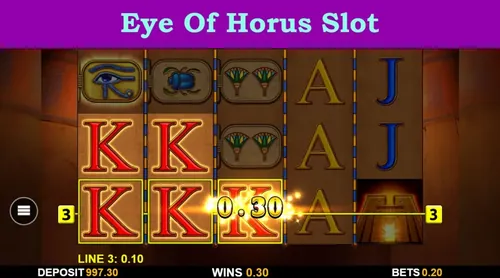
The game features a classic 5x3 reel layout with 10 fixed paylines, offering a structured environment for bankroll management without complex betting grids. This simple structure contrasts with the five-reel setup of El Torero, which also comes from Reel Time Gaming but lacks the specific expanding wild mechanics found here. Players can thus focus on symbol interactions rather than navigating intricate line patterns during their session.
Expanding wilds and stacked symbols drive the volatility profile, creating infrequent but significant payout opportunities within the high-variance framework. These mechanics are designed to trigger the free spins round where multipliers can accumulate, potentially reaching the maximum win cap of 10,000x the stake. Understanding this distribution helps players accept dry spells as part of the expected mathematical behavior of the software.
Bankroll rules that hold up
A disciplined bankroll strategy requires setting aside a specific amount of money separate from personal finances before accessing the Reel Time Gaming title. This capital must cover thousands of spins to withstand the high volatility inherent in Eye of Horus without triggering emotional decision-making. Treating this sum as entertainment expenditure ensures that losses do not impact essential living costs or financial obligations.
Flat betting involves wagering the same stake every round, which prevents rapid bankroll erosion during losing streaks common in high-volatility slots. This method contrasts sharply with progressive staking systems that raise stakes after losses, a practice that does not change the built-in edge and only accelerates the time to ruin. Maintaining constant bet sizes allows the 96.31% RTP to manifest more accurately over a larger sample size.
The welcome bonus terms often include a 300% match up to €2,000 plus 100 free spins, which can significantly extend playing time if used correctly. However, these funds usually carry wagering requirements that must be met through gameplay, effectively increasing the total turnover needed before withdrawal eligibility. Players should calculate the required turnover against their chosen stake to ensure the bonus remains mathematically viable.
Bet sizing against volatility
High volatility in Eye of Horus demands smaller relative bet sizes to sustain playthroughs through the inevitable dry periods between feature triggers. A stake that represents 0.1% of the total bankroll allows for approximately 1,000 spins, providing sufficient data points to experience the game's random number generator cycles. This ratio balances the risk of busting quickly against the potential for hitting the 10,000x max win threshold.
The symbol upgrade feature and Ancient Egyptian theme work together to create visual variety, but they do not alter the underlying probability distribution of the reels. Unlike El Torero, which offers a max win of 1000x, Eye of Horus provides a much higher ceiling that justifies the patience required for its volatile nature. Players seeking frequent small wins might find the hit frequency insufficient, making bet sizing crucial for satisfaction.
Calculating the cost per hour involves multiplying the spins per minute by the stake, then adjusting for the expected loss rate derived from the 3.69% house edge. For instance, a stake of 0.50 € with 500 spins per hour results in a theoretical hourly loss of roughly 9.25 €, assuming average performance. This metric helps players allocate their budget efficiently across different sessions without exceeding their predefined limits.
Session limits worth setting
Setting a time limit for each gaming session prevents fatigue-induced errors when interacting with the expanding wilds and free spins mechanics of Eye of Horus. Cognitive decline after extended play can lead to ignoring bankroll rules, such as placing bets that exceed the predetermined safe range. A fixed duration ensures that decisions remain rational and aligned with the initial strategic plan established before logging in.
Loss limits act as a hard stop mechanism, enforcing discipline when the high volatility of the Reel Time Gaming slot leads to consecutive non-winning spins. If a player reaches a predefined deficit, such as 50% of their starting bankroll, they must cease play regardless of the potential for a comeback. This rule protects against the gambler's fallacy, which incorrectly assumes that past losses influence future independent spin outcomes.
Win goals provide a logical exit point, allowing players to secure profits before the house edge gradually erodes their balance over time. Cash out once a target profit, such as 100% of the deposit, is achieved, rather than chasing the elusive 10,000x maximum win in every session. This approach converts theoretical returns into actualizable gains, preserving the value generated during successful variance swings.
Why chasing losses fails
Chasing losses involves increasing bet sizes to recover previous deficits, a strategy that fundamentally misunderstands the independence of each spin in Eye of Horus. The 96.31% RTP applies to the aggregate of all spins, not to individual attempts to reverse a negative trend, making recovery mathematically improbable. This behavior ignores the reality that the house edge remains constant regardless of the stake size or recent history.
Progressive staking systems, such as Martingale variants, double the stake after every loss, which quickly exhausts even large bankrolls due to table limits and finite resources. In a high-volatility game like Eye of Horus, a single long losing streak can deplete funds faster than any recovery system can replenish them. The risk of ruin approaches certainty when players attempt to force a statistical average through aggressive betting.
The psychological urge to win back money is exploited by the engaging Ancient Egyptian theme and visual effects, which mask the cold arithmetic of the game engine. Recognizing that the 10,000x max win is a rare outlier rather than an expectation helps players detach emotionally from short-term results. Accepting losses as the cost of entertainment preserves the integrity of the bankroll and prevents irreversible financial damage.
Eye of Horus: key facts
| Parameter | Value |
|---|---|
| Game | Eye of Horus |
| Studio | Reel Time Gaming |
| Released | 2016 |
| RTP | 96.31% |
| House edge | 3.69% |
| Volatility | high |
| Max win | 10,000x |
| Reels | 5x3 |
| Paylines / ways | 10 |
Common systems and their limits
Eye of Horus is a slot by Reel Time Gaming released in 2016, featuring a theoretical RTP of 96.31% with a house edge of 3.69%. This mathematical structure ensures that no betting system can overcome the built-in advantage over time. Players must accept that long-term returns are governed by this fixed percentage rather than strategy.
The game offers high volatility alongside a maximum win potential of 10,000x the stake on its 5x3 reel layout. Such variance creates irregular payout patterns that disrupt any attempt at consistent income generation through pattern recognition. System users often misinterpret these swings as predictable cycles despite the random number generator governing every spin.
Alternative configurations exist with RTPs of 94.83%, 92.44%, 90.25%, and 88.26%, further limiting systemic viability. Comparing Eye of Horus to Alles Spitze by Merkur reveals similar constraints where high volatility caps max wins at 500x. These structural limits prevent any staking plan from altering the fundamental negative expectation inherent in casino games.
Flat betting explained
Flat betting requires maintaining a constant stake size for every round regardless of previous outcomes or balance changes. This approach utilizes the 10 paylines on the standard 5x3 grid without attempting to manipulate bet sizes during winning or losing streaks. The method preserves bankroll longevity by avoiding rapid depletion through aggressive increases after losses.
Theoretical return calculations based on flat betting rely on the 96.31% RTP figure provided for the standard configuration. Over hundreds of thousands of spins, this percentage dictates the average loss rate per unit wagered across all rounds played. Players experience slower variance compared to progressive methods while retaining eligibility for features like expanding wilds and free spins.
Contrast this with Alles Spitze which carries an RTP of 90.85% and a lower maximum win cap of 500x. Flat betting remains effective here too but yields lower expected value due to the inferior return percentage. Maintaining identical stakes ensures that the house edge of 3.69% applies uniformly to every single wager placed throughout the session.
Progressive staking risks
Progressive staking involves raising stakes after losses to recover previous deficits through larger subsequent wins. This method does not change the built-in edge of 3.69% and only shortens the time to ruin for the player's bankroll. The high volatility of Eye of Horus exacerbates these risks by producing extended periods without significant payouts despite increased wagers.
The maximum win limit of 10,000x provides a hard ceiling on recovery potential regardless of how aggressively stakes are raised. Players chasing losses may exhaust their funds before hitting a large enough combination to offset earlier deficits. Features such as stacked symbols and symbol upgrades do not guarantee the frequency required to sustain progressive strategies effectively.
Alles Spitze presents different risk parameters with its 500x max win cap and 90.85% RTP under the Merkur brand. Progressive systems fail equally here because the lower ceiling restricts upside potential while the higher house edge accelerates losses. Mathematically, increasing bet sizes after defeats merely accelerates the realization of the negative expectation established at the start.
What the maths actually allows
The theoretical return of 96.31% represents an average outcome over very long runs involving hundreds of thousands of spins. This figure establishes a house edge of 3.69% which determines the expected loss rate for every euro wagered over time. Short sessions rarely align with this percentage due to the inherent randomness of the underlying algorithmic processes.
Other RTP configurations circulate including values of 94.83%, 92.44%, 90.25%, and 88.26% depending on specific operator settings. These variations directly impact the expected value available to players who engage with the slot across multiple platforms. Understanding these distinct percentages helps players assess the true cost of play relative to their chosen casino environment.
Comparative analysis shows Alles Spitze operates with a significantly lower RTP of 90.85% and a max win of 500x. The difference between 96.31% and 90.85% translates to a substantial gap in long-term retention expectations for players. Mathematical models confirm that higher RTP slots generally offer better survival rates for bankrolls subjected to identical betting volumes.
Reading variance honestly
High volatility defines the distribution of wins in Eye of Horus, creating infrequent but potentially large payouts up to 10,000x. This characteristic means players endure longer dry spells between winning combinations compared to low volatility alternatives. The 10 payline structure on the 5x3 grid influences how often winning alignments occur during standard gameplay sessions.
Expanding wilds and free spins serve as mechanisms to mitigate variance by introducing additional winning opportunities within bonus rounds. Stacked symbols and symbol upgrades further enhance payout potential during these special features triggered by scatter symbols. These elements provide temporary relief from variance but do not alter the fundamental probability distribution of base game outcomes.
Alles Spitze exhibits high volatility yet caps maximum wins at 500x with an RTP of 90.85% under the Gauselmann brand. The lower ceiling restricts the magnitude of variance rewards despite similar unpredictability in win frequency. Honest assessment requires acknowledging that variance management tools cannot override the statistical reality imposed by the game's mathematical model.
Learning the game in demo first
Eye of Horus is a slot developed by Reel Time Gaming, released in 2016 with a theoretical return to player rate of 96.31%. This percentage represents the long-term average payout over hundreds of thousands of spins, contrasting sharply with the house edge of 3.69% that the operator retains. Players can test these mechanics without financial risk using the demo mode before committing any real funds.
The layout consists of five reels and three rows, offering ten fixed paylines for potential winning combinations across each spin. High volatility indicates that wins occur less frequently but tend to be larger when they do happen compared to low variance titles. Understanding this distribution helps players set realistic expectations for their bankroll management during extended play sessions.
Adjusting stakes to your budget
The maximum win cap stands at 10,000x the total bet, providing a significant potential payout for high-risk strategies employed by experienced gamblers. A flat betting approach involves wagering the same stake every round, which prevents rapid depletion of the bankroll during losing streaks. This method ensures that players can sustain their gameplay longer than those using progressive staking systems after losses.
Recognising a bad session
Other RTP configurations in circulation include 94.83%, 92.44%, 90.25%, and 88.26%, which significantly alter the expected return on investment for participants. If a player encounters a version with an 88.26% return, the house edge rises to 11.74%, accelerating fund loss compared to the standard 96.31% variant. Recognizing these variations allows users to avoid tables with unfavorable mathematical edges during their gaming sessions.
Stopping while ahead
The expanding wilds feature can trigger free spins, potentially leading to substantial payouts if stacked symbols align effectively on the active paylines. Book of Dead by Play'n GO offers a max win of 5000x, whereas Eye of Horus provides double that potential at 10,000x the stake. Securing profits early prevents giving back winnings to the casino due to the inevitable impact of the house edge over time.
Responsible play in practice
A 300% welcome bonus up to €2,000 plus 100 free spins may encourage higher initial deposits, increasing the total amount at risk for new players. Setting a strict daily limit on the bankroll ensures that losses remain within affordable boundaries regardless of the bonus value received. Responsible gambling practices require separating entertainment costs from essential finances to maintain control over spending habits during online casino visits.
DemoRTP & VolatilitySymbols & PayoutsBonus FeaturesStrategyBonusesMobileDownload & AppMax WinSimilar GamesReviewFAQSitemap
Eye of Horus 2026